Inside Human Heart Anatomy: A Practical Visual Resource for Educators and Creators
Finding the right visual aid for medical or biological content is often more challenging than it appears. You might be a biology teacher preparing a lesson plan, a freelance designer working on a health brochure, or a parent helping a child with a science fair project. In all these scenarios, generic clip art falls short, and overly complex medical diagrams can confuse rather than clarify. This is where a high-quality Inside Human Heart Anatomy vector illustration becomes an indispensable tool. It bridges the gap between scientific accuracy and visual accessibility, offering a resource that is both educational and aesthetically pleasing.
The value of this specific asset lies in its versatility. It is not just a static image; it is a multi-format package designed to meet the diverse needs of modern content creation. Whether you are building a presentation for a hospital board meeting or creating a fun activity sheet for elementary students, having access to scalable vectors and high-resolution raster files ensures your final product looks professional. Let’s explore how different users can leverage this resource effectively in real-world situations.
Why Format Flexibility Matters in Real Projects
One of the most common frustrations for creators is receiving a file that doesn’t fit their workflow. You might need a transparent background for a website header, but the vendor only provides a JPEG with a white box around it. Or perhaps you need to enlarge a diagram for a poster, and the pixelated result ruins the design. This Human Body Parts Anatomy Vector Illustration solves these issues by providing three distinct file types, each serving a specific purpose.
- EPS Files: These are vector-based, meaning they can be scaled to any size without losing quality. If you are a graphic designer printing a large banner for a medical conference or a small flyer for a clinic, the EPS file ensures crisp lines and clean text every time.
- Transparent PNGs: At 4MP and 2000 pixels, these pre-rendered files are perfect for digital use. The transparency allows you to layer the heart anatomy over colored backgrounds, textured slides, or other design elements without awkward white edges. This is ideal for bloggers and social media managers who need quick, plug-and-play visuals.
- High-Resolution JPEGs: Sometimes, simplicity is key. For documents, emails, or platforms that do not support transparency, the high-quality JPEG offers a reliable, universally compatible option that maintains clarity even when compressed.
Educational Applications: From Classroom to Lecture Hall
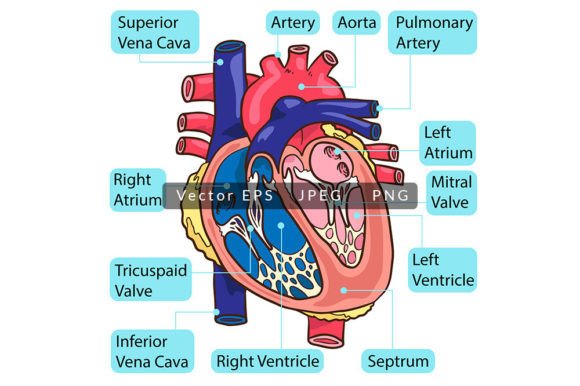
For educators, clarity is paramount. When teaching human body parts anatomy, students need to see the relationship between different structures clearly. A cluttered or low-quality image can distract from the learning objective. Teachers can use the vector illustration to create custom worksheets where labels are removed, allowing students to test their knowledge. Because the file is editable, you can highlight specific chambers of the heart or major blood vessels in different colors to match your lesson’s focus.
In higher education or medical training settings, the accuracy of the diagram supports more advanced discussions. Professors can integrate the high-resolution PNGs into PowerPoint presentations, ensuring that even when projected on a large screen, the details remain sharp. This helps in explaining complex physiological processes, such as blood flow dynamics, without the audience squinting to identify structures.
Creative and Commercial Uses for Designers and Marketers
Freelance designers and marketing professionals often work under tight deadlines. Searching for stock images that are both legally safe and visually consistent can eat up valuable hours. Having a dedicated Inside Human Heart Anatomy asset in your library streamlines this process. Imagine you are designing a brochure for a cardiology clinic. Instead of hiring an illustrator to draw a custom diagram, you can use the EPS file, adjust the colors to match the clinic’s branding, and place it seamlessly into your layout.
Bloggers and content creators in the health and wellness niche also benefit significantly. Articles about heart health, nutrition, or exercise often require visual breaks to keep readers engaged. The transparent PNGs allow for easy integration into blog posts, newsletters, and infographics. You can overlay text, add icons, or combine the heart illustration with other body part vectors to create comprehensive guides on human anatomy. This not only enhances the aesthetic appeal of your content but also improves user retention and shareability.
Supporting Kids’ Activities and Family Learning
Learning about the human body doesn’t have to be dry or intimidating for children. Parents and homeschoolers can use these illustrations to make science fun. The clean lines and clear structure of the vector art are suitable for coloring pages, puzzle creation, or interactive digital activities. You can print the black-and-white version for a coloring session, helping kids familiarize themselves with the shape and position of the heart while developing fine motor skills.
Furthermore, these visuals can serve as conversation starters during family health discussions. By using a friendly yet accurate representation of the heart, parents can explain basic concepts like why exercise is important or how food affects our bodies in a way that is accessible to younger audiences. The high resolution ensures that even when printed at home on standard paper, the image remains clear and engaging.
What to Consider Before Using Anatomical Illustrations
While having a versatile file package is advantageous, users should consider a few practical aspects before integrating these assets into their projects. First, think about your target audience. For a general audience or children, the simplified yet accurate style of this illustration is perfect. However, for specialized surgical training, you might need additional layers of detail that go beyond general anatomy. Understanding the scope of the illustration helps set realistic expectations.
Second, consider the technical requirements of your platform. If you are working primarily in web design, ensure your CMS supports PNG transparency. If you are printing, verify that your printer can handle the resolution provided by the JPEG or EPS files. Most modern printers will handle 2000 px images well for standard sizes, but for very large formats, the vector EPS is your safest bet.
Finally, always check licensing terms if you are using the image for commercial purposes. While this resource is designed for broad use, including commercial applications, confirming that you have the right to modify and distribute the final design is a crucial step for professional integrity.
Enhancing Communication Through Visual Clarity
In both personal and professional contexts, effective communication relies on shared understanding. Anatomical diagrams serve as a universal language, transcending verbal barriers. A doctor explaining a condition to a patient, a trainer demonstrating proper posture, or a writer describing emotional metaphors related to the heart—all benefit from a clear, recognizable visual reference. The Inside Human Heart Anatomy illustration provides this common ground.
By choosing a resource that offers multiple formats and high resolution, you invest in the longevity and adaptability of your content. You are not just buying an image; you are acquiring a tool that can evolve with your needs. Whether it is resized for a mobile app icon, printed for a classroom poster, or edited for a corporate report, the quality remains consistent. This reliability saves time, reduces stress, and ultimately leads to better outcomes in whatever project you are undertaking.
In conclusion, integrating high-quality anatomical visuals into your work is a small step that yields significant returns in engagement and clarity. By understanding the specific benefits of vector and raster formats, and by aligning the resource with your audience’s needs, you can create content that is not only informative but also visually compelling. Whether you are educating, marketing, or creating for fun, the right illustration makes all the difference.