Mastering Mixed Equations Math Grades 6-8: A Comprehensive Guide to Algebraic Fluency
The transition from basic arithmetic to algebraic thinking is one of the most critical milestones in a student's mathematical education. For learners navigating Mixed Equations Math Grades 6-8, the ability to seamlessly switch between operations and variables is not merely an academic requirement; it is a foundational skill for logical reasoning and problem-solving in the real world. Whether you are a classroom educator managing a diverse range of learning speeds, a homeschooling parent seeking structured curriculum support, or a tutor aiming to bridge gaps in understanding, the approach to teaching these concepts must be both rigorous and accessible.
At the heart of this developmental stage lies the concept of mixed equations—problems that combine integers, variables, and multiple operations into single expressions. Consider a typical challenge found in this domain: 8 - 4 - 7x2. At first glance, this may appear simple, but without a firm grasp of the order of operations (PEMDAS/BODMAS) and the properties of integers, students can easily stumble. The subtraction, multiplication, and the potential for negative results create a complex cognitive load that requires deliberate practice. This is where targeted resources become indispensable.
The Cognitive Shift: From Arithmetic to Algebraic Reasoning
In grades 6 through 8, mathematics evolves from calculating specific numbers to manipulating abstract symbols. Students must learn that 'x' is not just a placeholder but a dynamic value that interacts with constants through addition, subtraction, multiplication, and division. This shift often creates a "learning cliff" where students who excelled in elementary math suddenly struggle because the rules have expanded rather than changed.
Mixed equations serve as the training ground for this new way of thinking. They force the learner to pause and analyze the structure of a problem before executing a calculation. When a student encounters an expression involving both positive and negative integers alongside variables, they must prioritize operations correctly. For instance, in the example mentioned earlier, the multiplication of 7 and 2 must occur before the subtractions are processed. If a student attempts to solve strictly from left to right without regard for operation hierarchy, the result will be incorrect. Mastery of these problems builds the mental discipline required for higher-level algebra, calculus, and even computer programming logic.
Why Practice Volume Matters in Mathematical Proficiency
Research in educational psychology consistently highlights the importance of distributed practice and volume in acquiring procedural fluency. Unlike conceptual understanding, which can sometimes be grasped through a single explanation, procedural skills like solving mixed equations require repetition to move from short-term memory to long-term automaticity. This is why extensive problem sets are vital.
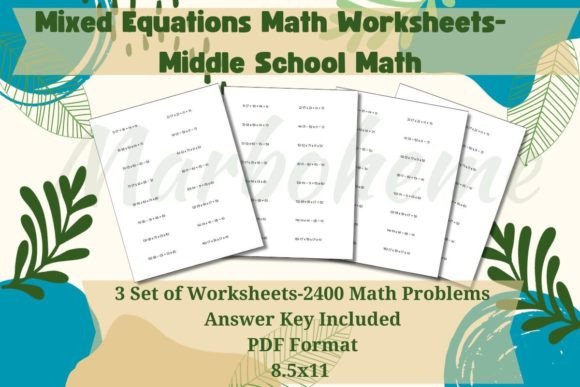
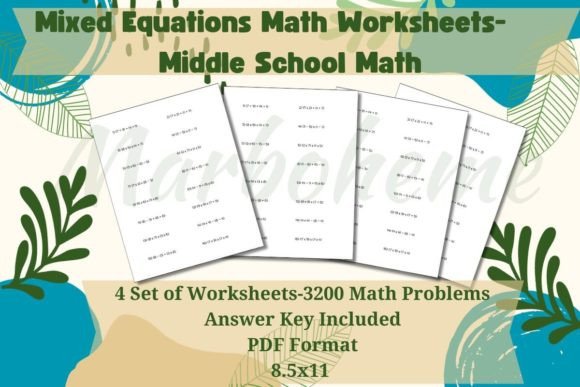
A robust collection of problems, such as a set containing 3,200 thoughtfully crafted exercises, provides the necessary depth for this mastery. With such a vast array, educators can ensure that no two students follow the exact same path to proficiency. Some learners may need more exposure to negative number multiplication, while others might struggle with multi-step subtraction. A large dataset allows for differentiation without requiring the teacher to manually generate hundreds of unique variations. It ensures that every student encounters enough variation to recognize patterns and internalize rules, rather than simply memorizing the answers to a few specific problems.
Structuring Learning Through Packetized Progression
One of the most effective strategies for managing a curriculum for Mixed Equations Math Grades 6-8 is the use of a packetized structure. Instead of overwhelming a student with a monolithic list of thousands of problems, dividing the content into manageable segments—such as four distinct packets of 800 problems each—creates a sense of achievable progress. This modular approach aligns with the pedagogical principle of scaffolding, where learning is broken down into smaller, digestible chunks.
Each packet can be designed to target specific nuances of mixed equations. The first packet might focus on basic integer operations with simple variables, ensuring the student understands the mechanics. Subsequent packets can introduce greater complexity, such as larger integers, negative coefficients, or equations that require rearranging terms before solving. This progressive difficulty curve prevents frustration and keeps learners engaged. When a student completes a packet of 800 problems, they receive a tangible sense of accomplishment, reinforcing their confidence and motivation to tackle the next level.
Furthermore, this structure offers logistical benefits for educators. Teachers can assign a specific packet as a weekly goal, using the completion rate as a metric for pacing. Homeschooling parents can utilize these packets to structure a semester's worth of work, knowing that the material is balanced and comprehensive. The organization reduces the administrative burden of lesson planning, allowing adults to focus on instruction and mentorship rather than content creation.
The Role of Immediate Feedback and Answer Keys
Perhaps the most critical component of any self-paced or independent learning resource is the availability of accurate feedback. In the context of mixed equations, where a single sign error can lead to a completely wrong answer, having a detailed answer key is non-negotiable. An answer key does more than just provide the final number; it serves as a diagnostic tool for both the student and the instructor.
When a student checks their work against a meticulous answer key covering all 3,200 problems, they can immediately identify errors. This immediate feedback loop is essential for correcting misconceptions before they become entrenched habits. If a student consistently misses problems involving negative multiplication, the pattern becomes visible, signaling a need for targeted review. Without an answer key, students may continue practicing incorrectly, reinforcing wrong methods under the guise of effort.
For educators, the answer key streamlines the assessment process. Grading thousands of problems manually is time-consuming and prone to human error. A comprehensive key allows teachers to quickly verify student work, providing them with more time to offer personalized guidance. It also enables peer-review activities, where students can check each other's work, fostering a collaborative learning environment where explaining solutions deepens understanding for both parties.
Practical Implementation: Format and Accessibility
In the modern educational landscape, the format of learning materials plays a significant role in their adoption and effectiveness. Digital products delivered in PDF format offer unparalleled convenience and compatibility. These files are universally accessible across various devices, from desktop computers and laptops to tablets and smartphones. This flexibility is crucial for today's hybrid learning environments, where instruction may take place in a physical classroom, at home, or online.
The standard 8.5x11 paper size optimization ensures that when these worksheets are printed, they fit perfectly on standard printer paper without awkward margins or scaling issues. Clear typography and readable layouts are essential for maintaining student focus. Cluttered or poorly formatted pages can distract from the mathematical content, leading to avoidable errors. A well-designed worksheet presents the problem clearly, leaving ample space for the student to show their work—a practice that is highly encouraged in mathematics education to track the logical steps taken to reach a solution.
Moreover, the digital nature of these resources allows for easy storage and retrieval. Educators can archive previous years' assignments, share resources with colleagues via email or cloud storage, and update their curriculum libraries efficiently. For homeschooling families, this means a sustainable, reusable resource that can be printed multiple times if needed, offering cost-effectiveness and environmental friendliness compared to purchasing multiple physical workbooks.
Real-World Relevance of Equation Solving Skills
While mixed equations may seem abstract to a middle school student, the skills developed through mastering them have profound real-world applications. Financial literacy, for example, relies heavily on the ability to manipulate variables and constants. Calculating interest rates, budgeting expenses, or determining profit margins often involves equations similar to those practiced in grades 6-8. Understanding how different values interact within an equation mirrors the decision-making processes required in business and personal finance.
In the fields of engineering and science, the ability to model situations using mathematical expressions is fundamental. Whether calculating the trajectory of a projectile or analyzing chemical reaction rates, professionals rely on the same principles of order of operations and variable manipulation that students learn through mixed equation worksheets. By building a strong foundation in these areas early, we prepare students for future careers that demand analytical precision and logical rigor.
Empowering Educators and Parents
The journey toward mathematical excellence is a shared responsibility between schools, families, and the tools they use. Resources designed specifically for Mixed Equations Math Grades 6-8 empower adults to take an active role in this process. By providing clear, structured, and extensive materials, these tools reduce the anxiety often associated with teaching math. Educators no longer need to spend hours creating custom worksheets; instead, they can focus on interpreting student performance and delivering targeted interventions.
Homeschooling parents, in particular, benefit from the clarity and progression offered by packetized resources. The fear of "not knowing enough math" to teach their children is alleviated when the curriculum is self-contained, complete with answer keys and structured progression. The focus shifts from content generation to facilitation, allowing parents to guide their children through challenges with confidence.
Ultimately, the goal is to revolutionize math education by making it more accessible, engaging, and effective. By leveraging high-quality digital products that offer thousands of problems, detailed solutions, and user-friendly formats, we can unlock the full potential of every learner. The path to mastery is paved with practice, clarity, and the right tools. As we continue to refine our approaches to teaching mixed equations, we equip the next generation with the cognitive skills necessary to navigate an increasingly complex world.