Transforming Mathematical Proficiency: The Strategic Value of Mixed Equations Math-Grades 6-8
In the rapidly evolving landscape of education, the demand for resources that bridge the gap between foundational arithmetic and advanced algebraic thinking has never been more critical. For educators, homeschooling parents, and educational entrepreneurs, the focus is shifting from rote memorization to deep conceptual understanding. At the heart of this pedagogical shift lies a specific, high-impact tool: Mixed Equations Math-Grades 6-8. This resource represents more than just a collection of problems; it is a structured intervention designed to elevate math education by transforming learning into an exciting mathematical adventure.
The transition from elementary mathematics to middle school algebra is often described as a "cliff" where many students lose confidence. By integrating mixed equations—problems that combine various operations and variable types—into the curriculum, we address the cognitive flexibility required for higher-level STEM fields. Whether you are a professional educator managing a diverse classroom or a parent curating a personalized learning path, understanding the mechanics and benefits of these worksheets is essential for fostering long-term academic success.
The Pedagogical Imperative of Mixed Equation Practice
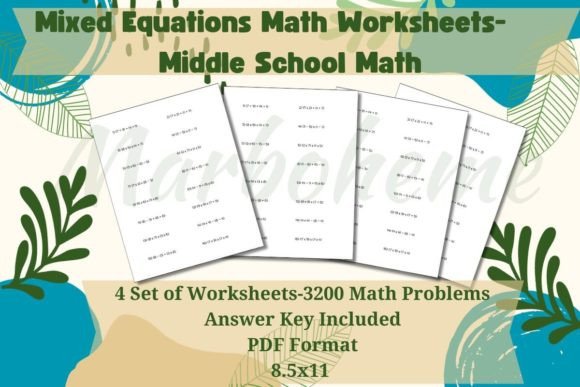
To understand why Mixed Equations Math-Grades 6-8 is gaining traction, one must first define what constitutes a "mixed equation" in this context. Unlike traditional worksheets that isolate a single skill—such as solving for x with only addition—mixed equations require students to navigate a complex problem set involving multiple operations simultaneously. A typical problem might look like 8 - 4 - 7x = 2, demanding that the student apply the order of operations, inverse operations, and algebraic manipulation in a single workflow.
This approach mirrors real-world problem-solving scenarios where challenges rarely present themselves in isolation. In the broader industry of educational technology and curriculum design, there is a growing consensus that "siloed" learning hinders retention. Students who practice exclusively on single-skill drills often struggle when faced with standardized tests or real-life applications that require them to identify which strategy to deploy. Mixed equation practice forces the brain to categorize the problem type before executing the solution, a meta-cognitive skill that is invaluable across all disciplines.
Bridging the Gap Between Arithmetic and Algebra
Grades 6 through 8 represent a pivotal developmental window. Students are moving from concrete operational thinking to abstract reasoning. Mixed Equations Math-Grades 6-8 serves as the critical scaffolding during this transition. It allows learners to apply their knowledge of integers, fractions, and decimals within an algebraic framework. This integration ensures that mathematical fluency is not lost but rather expanded.
For instance, a student proficient in integer subtraction may falter when that same operation is embedded within a linear equation. By exposing students to extensive problem sets that blend these concepts, educators can identify gaps in understanding early. This proactive approach aligns with modern data-driven teaching methodologies, where continuous assessment informs instruction.
Market Trends and the Shift Toward Comprehensive Digital Resources
The education market is witnessing a significant transformation driven by the need for efficiency and depth. Educators and parents are increasingly seeking digital products that offer comprehensive coverage without sacrificing quality. The rise of Mixed Equations Math-Grades 6-8 worksheets reflects a consumer trend toward "all-in-one" solutions that reduce preparation time while maximizing instructional value.
Professionals in the ed-tech sector recognize that the most successful tools are those that adapt to diverse learning environments. Whether in a public school classroom, a private academy, or a home-school setting, the core requirement remains the same: rigorous, engaging content that prepares students for future challenges. The shift away from generic, low-volume workbooks toward high-density, curated problem sets indicates a maturation in how stakeholders view educational materials. They are no longer looking for fillers; they are investing in assets that drive measurable outcomes.
The Role of Volume and Variety in Mastery
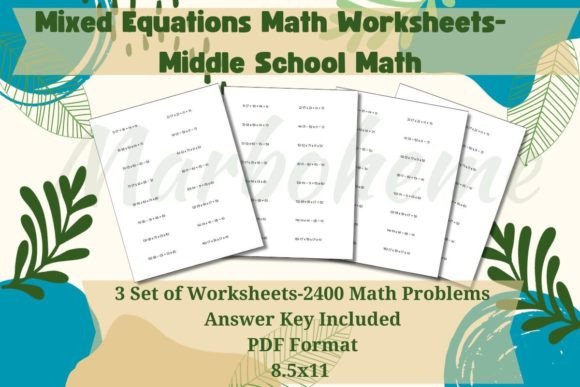
A key differentiator in high-quality educational resources is the sheer volume of practice opportunities. Our digital product addresses this with an extensive problem set comprising a whopping 2400 carefully curated problems. This volume is not arbitrary; it is rooted in the science of spaced repetition and mastery learning. To truly internalize the intricacies of mixed equations, students need exposure to a wide variety of scenarios.
Consider the workflow of a teacher planning a semester. With a resource offering three packets, each containing 800 problems, educators can structure their curriculum with precision. This packetized convenience allows for modular learning experiences. Teachers can assign specific subsets of problems based on class performance, ensuring that struggling students receive targeted support while advanced learners remain challenged. This flexibility is a cornerstone of differentiated instruction, a standard expectation in modern pedagogy.
Empowering Educators and Parents with Data-Driven Tools
One of the most significant barriers to effective math tutoring is the time required for grading and feedback. In a busy professional environment, whether for a full-time teacher or a working parent, efficiency is paramount. The inclusion of a comprehensive answer key transforms the utility of these worksheets from a mere assignment generator to a powerful diagnostic tool.
Elevate Math Education with Mixed Equations Worksheets by empowering educators to facilitate easy grading. When an answer key is detailed and accurate, it aids in guiding students through the problem-solving process immediately after completion. This rapid feedback loop is crucial for correcting misconceptions before they become entrenched habits. For homeschooling parents, this feature is particularly vital, as they often wear multiple hats as instructor, administrator, and evaluator.
Operational Efficiency in the Classroom and Home
From a logistical standpoint, the format of educational materials plays a significant role in adoption. These worksheets are presented in PDF format, ensuring compatibility across all devices and operating systems. The convenience of effortless printing on standard 8.5x11 paper means that no special equipment or software is required. The optimal size provides clarity and readability, reducing visual strain for students of all ages.
This attention to detail reflects a broader trend in the creator economy: the prioritization of user experience (UX). Just as software developers optimize interfaces for usability, educational creators are optimizing physical formats for accessibility. The result is a seamless integration into existing workflows. Teachers can print a packet in seconds, distribute it, and immediately begin instruction, knowing the material is professionally formatted and ready for use.
Why Stakeholders Are Investing in Deep Conceptual Understanding
Why are professionals, creators, and parents paying such close attention to resources like Mixed Equations Math-Grades 6-8? The answer lies in the changing expectations of the workforce and higher education. As automation and artificial intelligence take over routine calculations, the human ability to reason logically and solve complex, multi-step problems becomes the primary competitive advantage.
Mathematics is no longer just about getting the right answer; it is about the journey of logic. Mixed equations force students to analyze the structure of a problem, determine the necessary steps, and execute a plan. This mirrors the analytical skills required in coding, engineering, finance, and data science. By choosing resources that foster a deep understanding of mathematical concepts, stakeholders are effectively preparing students for a future where adaptability and critical thinking are currency.
Building Confidence Through Challenge and Enjoyment
There is a misconception that rigorous math practice must be tedious. However, the right balance of challenge and enjoyment can transform the learning experience. Our worksheets are designed to provide a perfect blend of both. When students successfully navigate a complex mixed equation, they experience a genuine sense of accomplishment. This positive reinforcement builds the confidence necessary to tackle even more difficult concepts.
Furthermore, the structured nature of the three-packet system offers a clear progression. Students can see their own growth as they move from the first packet to the third. This gamification of progress, combined with the tangible satisfaction of solving intricate problems, helps maintain engagement. In an era where attention spans are fragmented, providing a focused, rewarding intellectual challenge is a powerful strategy for maintaining student interest.
Conclusion: Preparing for Success in a Complex World
The integration of Mixed Equations Math-Grades 6-8 into educational routines is more than a tactical choice; it is a strategic investment in the future capabilities of learners. By leveraging extensive problem sets, detailed answer keys, and user-friendly formats, these resources address the evolving needs of educators, parents, and students alike.
As we look forward, the demand for high-quality, adaptable, and comprehensive math resources will only increase. The ability to synthesize information, apply multiple strategies, and solve non-linear problems is at the core of modern success. Transforming learning into an exciting mathematical adventure is not just a slogan; it is the outcome of meticulous design and a commitment to excellence. For anyone dedicated to elevating math education, these worksheets offer the tools necessary to guide students toward a future defined by clarity, confidence, and competence.